
Chapter 3.
Unlock the Wires
Published
Grid expansion is falling far behind America’s needs
Throughout most of the country, transmission system expansion has slowed significantly, with only piecemeal additions to satisfy the growing generator interconnection queue or substantial new generation projects.1 While recent analysis of Department of Energy modeling estimates the nation must build 5,000 miles of high-capacity transmission lines each year, only 888 miles were completed in 2024.2 Many parts of today’s original electric grid are nearly 100 years old.3 Upgrading and expanding the transmission system is essential to unlocking new resources that can ensure clean, cheap, reliable electricity that supports economic growth for all Americans.
Fragmented planning processes and a lack of centralized, long-term coordination have created a system that is too slow to adapt to new forms of demand, increased interconnection requests, and to the economic competitiveness of renewable energy. These challenges are further compounded by the time required to build new high-voltage transmission lines, which can take 10 years or more.4
States can unlock more capacity and other benefits from our existing grid with advanced transmission technologies
While long-term fixes to the way we plan, permit, and pay for transmission are necessary, we have solutions now that will enable us to do more with the grid we have today. Mature advanced transmission technologies (ATTs) can enable us to unlock significant additional capacity in the short-term at a lower cost than greenfield transmission and traditional grid upgrades. ATTs can similarly provide reliability, resiliency, and efficiency benefits while supporting a more flexible grid. In order to do so, operators must first identify areas of congestion or unrealized value on the grid, and then appropriately channel enhancements that deliver that value to customers.
This section outlines actions state policymakers and utilities can pursue to unlock advanced transmission technologies and add more capacity to the grid across two main areas: planning and permitting ATTs, and incentives and financing.
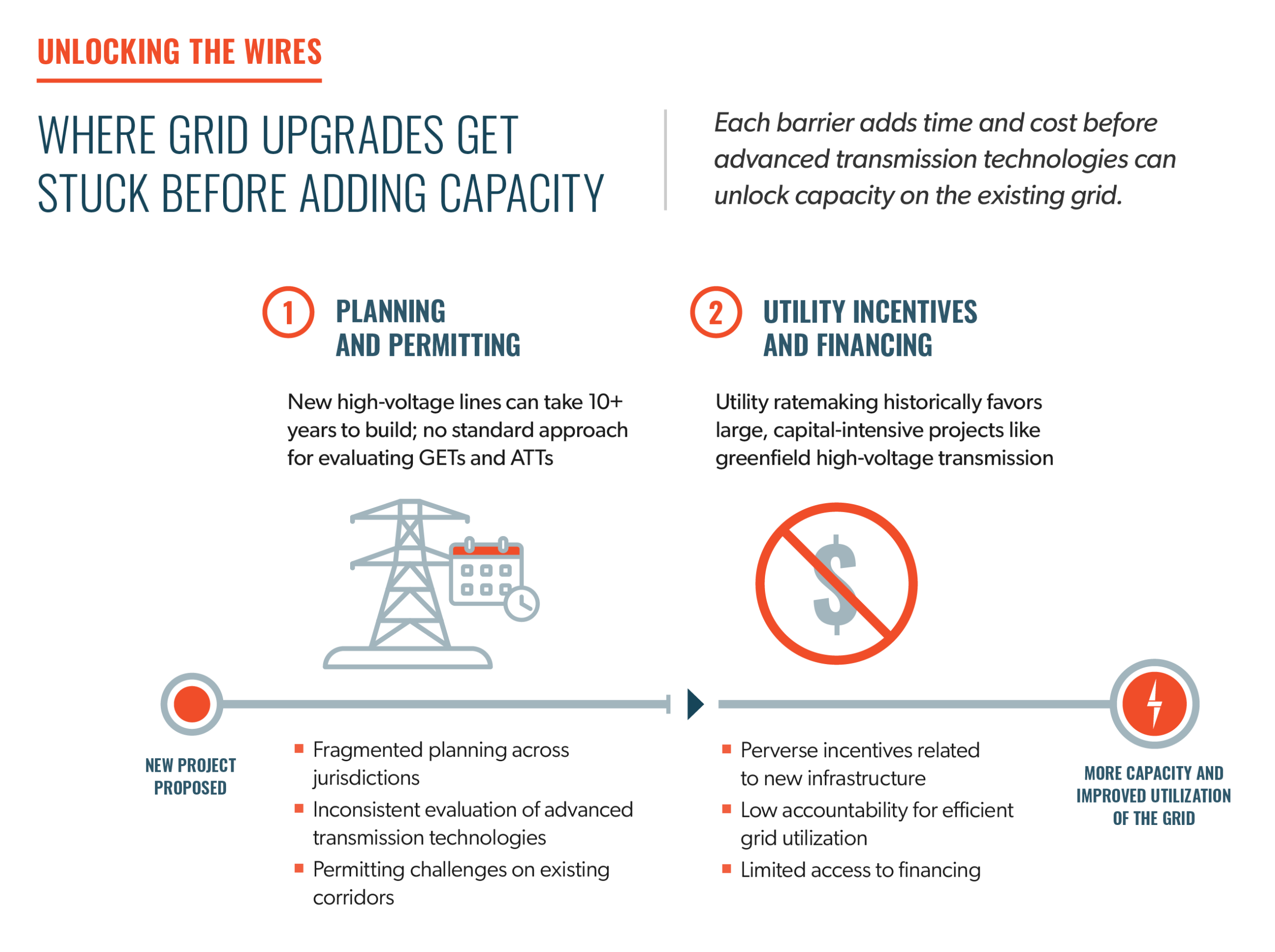
Text version of this graphic
Where grid upgrades get stuck before adding capacity. Each barrier adds time and cost before advanced transmission technologies can unlock capacity on the existing grid.
From “Grid need identified” to “More capacity and improved utilization of the grid”:
- Planning and permitting. New high-voltage lines can take 10+ years to build; no standard approach for evaluating GETs and ATTs.
- Fragmented planning across jurisdictions
- Inconsistent evaluation of advanced transmission technologies
- Permitting challenges on existing corridors
- Utility incentives and financing. Utility ratemaking historically favors large, capital-intensive projects like greenfield high-voltage transmission.
- Perverse incentives related to new infrastructure
- Low accountability for efficient grid utilization
- Limited access to financing
States can improve planning and permitting for ATTs with policies that:
- Coordinate planning across jurisdictions by requiring utilities to report on grid constraints and relief opportunities, evaluating ATTs in regional planning, and improving technical capacity at regulatory bodies.
- Establish consistent evaluation of ATTs by requiring analysis of alternatives in planning and approvals, conducting technology assessments, considering storage, and future-proofing investments to enable future expansion.
- Streamline permitting for upgrades to existing corridors by defining exemptions for certain grid upgrades, setting timelines and coordinating review processes across multiple agencies.
States can reform utility incentives and financing for ATTs with policies that:
- Align incentives with efficient infrastructure investment through shared savings mechanisms and rewarding utilities for cost-effective deployment of ATTs.
- Strengthen accountability for efficient grid utilization by requiring measurement and reporting of transmission grid utilization and developing performance incentives for improved utilization of the grid.
- Expand access to financing through state transmission finance authorities and clarifying cost recovery for ATTs.
Sources
- Nathan Shreve, Zach Zimmerman, Gretchen Kershaw, and Rob Gramlich, Fewer New Miles: Strategic Industries Held Back by Slow Pace of Transmission, rev. 1 (Grid Strategies and Americans for a Clean Energy Grid, July 2025), https://cleanenergygrid.org/wp-content/uploads/2025/07/ACEG_Grid-Strategies_Fewer-New-Miles-2025_Rev-1.pdf (opens in a new tab). ↩︎
- Shreve et al., Fewer New Miles. ↩︎
- U.S. Department of Energy, Advanced Transmission Technologies: Report to Congress (December 2020), https://www.energy.gov/oe/articles/advanced-transmission-technologies-report-508 (opens in a new tab). ↩︎
- Ryan Wiser et al., Transmission Impact Assessment: Power Sector Infrastructure Deployment to Reduce Costs, Improve Reliability, and Lower Pollution (U.S. Department of Energy, October 2024), https://www.energy.gov/sites/default/files/2024-10/DOE_OP_2024_Report-Transmission_Impact_Assessment.pdf (opens in a new tab). ↩︎