
Chapter 2.
Unlock Customer and Local Clean Energy
Published
Small-scale clean energy can provide fast and flexible power
Customer and local clean energy projects – such as rooftop or community-scale solar, batteries, electric vehicles, smart thermostats and other home appliances – were once considered to be too expensive and difficult to scale to be as impactful on the grid as large-scale clean energy projects. But, their potential to serve as a key pillar to unlock the grid is clear as resource costs have fallen and new technology has made it easier to coordinate them. By connecting at a home, business, or on the local low-voltage distribution grid, these resources can add capacity unconstrained by long-range transmission traffic jams and can often be connected to the grid faster than large projects.
As of August 2026, small-scale solar deployment in the United States (considered to be projects < 5 MW) was at 62 GW (opens in a new tab), making up nearly a third of all solar installations in the country, and coordinated local resources provided 37.5 GW of capacity (opens in a new tab) as of September 2025.1 Together customer and local projects can quickly respond to grid needs, avoiding larger system costs while providing energy and capacity value.
The potential for customer and local power is enormous
According to the U.S. Department of Energy:
- Coordinated local resources could:
- Provide 80-160 GW (opens in a new tab) of peak capacity by 2030,2 the equivalent of 100 to 200 large-scale power plants
- Meet peak demand at 56% of the cost (opens in a new tab) of a gas peaking turbine and come online in less than six months.3
- Local solar alone could grow to 190 GW by 2035 (opens in a new tab) with permitting and interconnection reform.4
Structural barriers are preventing customer and local energy resources from realizing their full potential
Customer and local clean energy can grow quickly, and at the scale needed to meet growing demand. However, customer and local clean energy projects still face significant barriers in permitting and interconnection that slow adoption and raise costs, even as the distribution system has significant headroom to connect more projects much of the time. States can address these barriers through automatic permitting, flexible connection, and increased transparency into hosting capacity and grid utilization.
Connecting more customer and local resources to the grid quickly is the first step, but their full potential lies in deployment and operation in a coordinated way to provide value across all levels of the grid. A multi-pronged approach is needed to access the full value of coordinated customer and local resources, one that creates clarity in programs and market structures for compensation and works toward solutions to siloed decision-making and misaligned incentives within utilities.
This section outlines actions state policymakers can pursue in three areas: permitting, grid connection, and mobilizing investment and coordinating resources.
Text version of this graphic
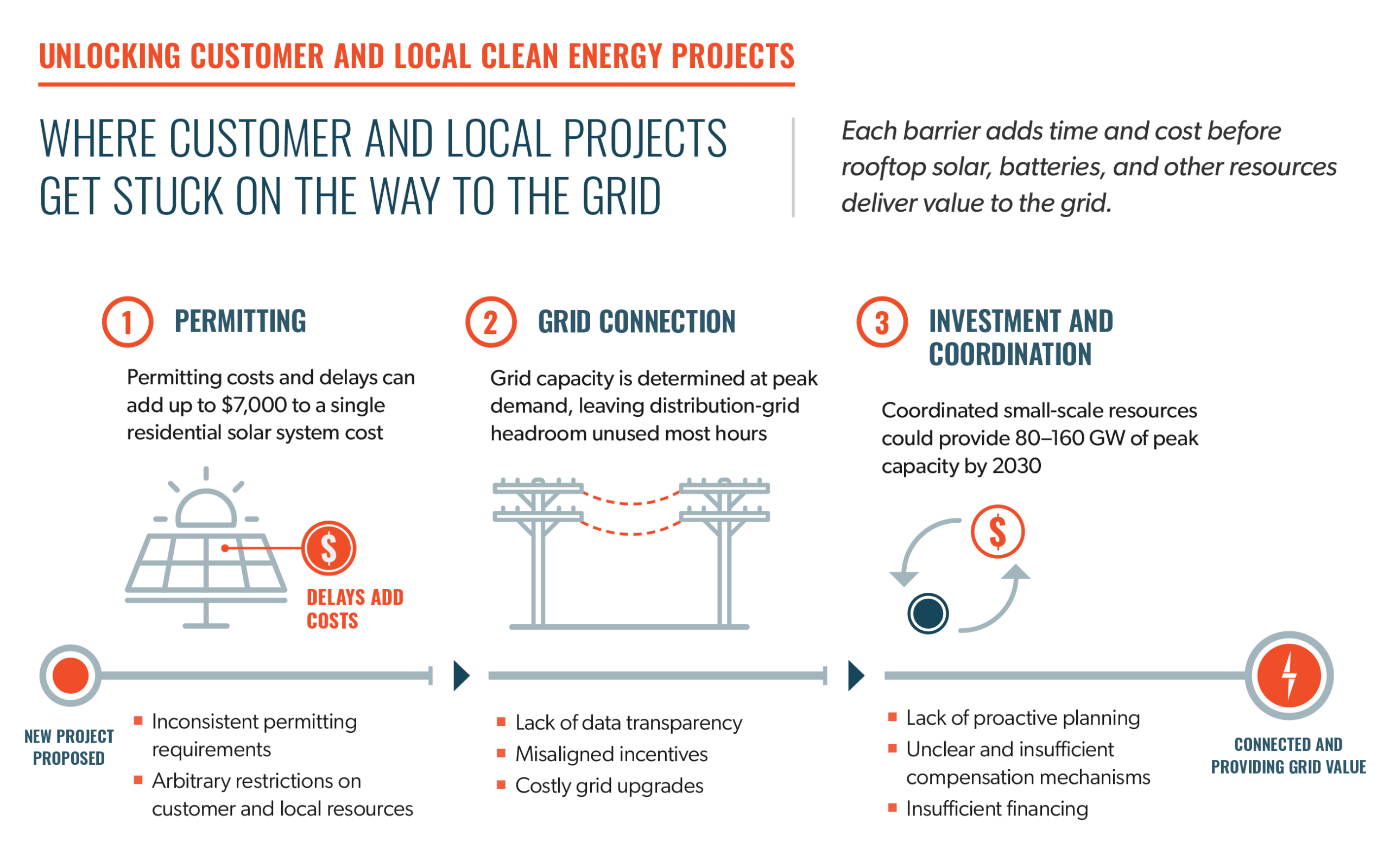
Where customer and local projects get stuck on the way to the grid. Each barrier adds time and cost before rooftop solar, batteries, and other resources deliver value to the grid.
From “New project proposed” to “Connected and providing grid value”:
- Permitting. Permitting costs and delays can add up to $7,000 to a single residential solar system cost.
- Inconsistent permitting requirements
- Arbitrary restrictions on customer and local resources
- Grid connection. Grid capacity is determined at peak demand, leaving distribution-grid headroom unused most hours.
- Lack of data transparency
- Misaligned incentives
- Costly grid upgrades
- Investment and coordination. Aggregated small-scale resources could provide 80–160 GW of peak capacity by 2030.
- Lack of proactive planning
- Unclear and insufficient compensation mechanisms
- Insufficient financing
States can improve customer and local clean energy permitting with policies that:
- Create consistent permitting requirements by creating standardized automated permitting for customer and local clean energy projects, allowing plug-in solar and batteries, and allowing remote and third-party inspections.
- Ease restrictions on customer and local resources by setting sensible limits on homeowners associations and building codes that prevent people from installing clean energy.
States can connect customer and local clean energy to the grid faster with policies that:
- Create more data transparency, for instance through public hosting capacity maps and grid utilization data.
- Better align incentives by rewarding utilities for improving interconnection timelines, while allowing third parties to complete interconnection studies.
- Reduce the cost of grid upgrades through flexible grid connections, fair allocation of interconnection costs, and streamlined approval of interconnections in locations with headroom on the grid.
States can mobilize investment and strengthen coordination of customer and local clean energy with policies that:
- Plan proactively for distributed clean energy resources in distribution system planning and consider customer and local resources in integrated system plans.
- Create clear and sufficient compensation mechanisms through customer programs, modern time-varying rates, access to wholesale markets, and improved competitive retail offerings.
- Unlock financing for customer and local clean energy by enabling utilities and large customers to procure distributed resources to meet their needs, and creating or expanding green banks to finance customer and local clean energy projects.
Sources
- U.S. Energy Information Administration (EIA), “Table 6.1.A. Estimated Net Summer Solar Photovoltaic Capacity from Utility and Small Scale Facilities (Megawatts),” Electric Power Monthly, October 23, 2026, accessed October 27, 2026, https://www.eia.gov/electricity/monthly/epm_table_grapher.php?t=table_6_01_a (opens in a new tab). Wood Mackenzie, “Virtual Power Plant Capacity Expands 13.7% Year-over-Year to Reach 37.5 GW, According to Wood Mackenzie,” September 17, 2025, https://www.woodmac.com/press-releases/virtual-power-plant-capacity-expands-13.7-year-over-year-to-reach-37.5-gw (opens in a new tab). ↩︎
- Yusuf Latief, “Tripled VPP Capacity Can Save $10B in Grid Costs Finds U.S. Energy Department,” Renewable Energy World, September 20, 2023, https://www.renewableenergyworld.com/news/tripled-vpp-capacity-can-save-10bn-in-grid-costs-finds-us-energy-department/ (opens in a new tab). ↩︎
- U.S. DOE, Pathways to Commercial Liftoff: Virtual Power Plants 2025 Update (January 2025), PDF p. 18, https://climateprogramportal.org/wp-content/uploads/2025/02/LIFTOFF_DOE_VirtualPowerPlants2025Update.pdf#page=18 (opens in a new tab). ↩︎
- U.S. Department of Energy (DOE), Distributed Energy Resource Interconnection Roadmap: Transforming Interconnection by 2035 (January 16, 2025), https://www.energy.gov/sites/default/files/2025-01/i2X%20DER%20Interconnection%20Roadmap.pdf (opens in a new tab). ↩︎